How HASH works
Easily connect any data
Applications you use, databases, data warehouses, fileshares, sensor data, chats, emails, activity logs.
Optionally install HASH's desktop app to passively gather new organizational knowledge.
Your graph-backed world model is assembled
An ontology and matching entities are automatically extracted into a knowledge graph. Processes are mapped in the background, and your graph is continuously checked and enriched.
Use HASH
Optimize and automate processes. Run simulations to test what-if hypotheses. Visualize data, and set up alerts. Improve decision-making.
Types, entities, and processes can be viewed and edited at any time.
from any application
+ 48 more
from files, docs, and notes
+ 37 more
from emails, calls, and chats
+ 24 more
from physical sensors
+ 12 more
HASH webs
Are private self-building
knowledge graphs

from offline sources
+ 3 more
from databases/warehouses
+ 5 more
from the world wide web
Passively as you browse
Entities automatically created and enriched on load
Automatically in the background
Monitor the web and automate keeping data up-to-date
Paywalls
Social Media
from other HASH webs
Secure private sharing
Share specific data safely between knowledge graphs and organizations
Access public data
Subscribe to free public or paid proprietary data in other webs, and optionally even publish your own
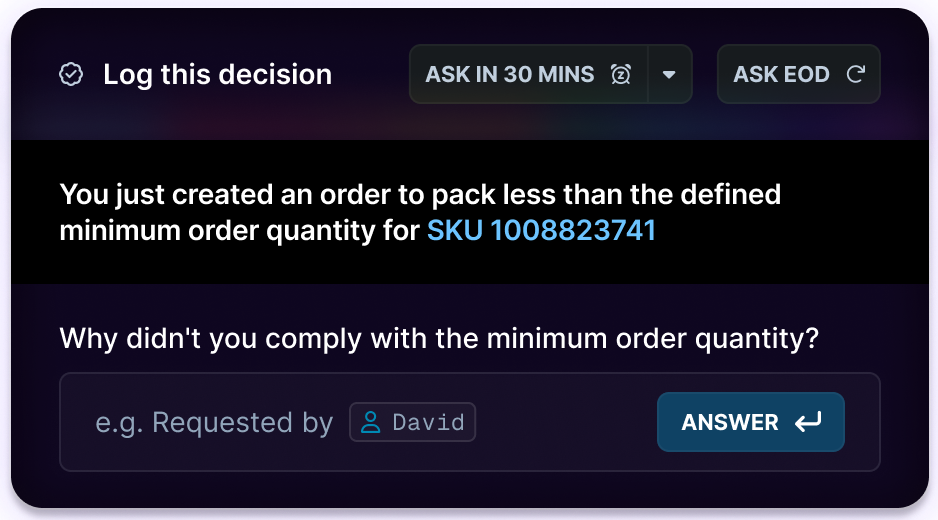
Map processes
without the overhead cost
Passively mine processes and optionally auto-ask questions to gather additional context when human decisions and actions are taken that differ from predicted or recommended norms.
“HASH is like having a team of expensive consultants deployed in the field 24/7, asking the right questions... all without bothering staff.”
Supports
Root Cause Analysis
Audit & Compliance
AI Training
Improve decision-making
where it's needed the most
Train AI models and benefit from AI-powered recommendations that optimize any step of any process in your business
Supports
Decision Support
Optimization
Risk
Save time and money
with automation and agentic AI
Automate whole processes or specific steps within them using HASH integrations and powerful agentic AI.
“Before HASH came along, building AI agents that worked reliably was a painful process. Now we specify our goals and constraints and it couldn’t be simpler.”
Enables
Robotic Process Automation
Agentic AI
Connect to third-party AI assistants
Give ChatGPT, Copilot, Claude and other third-party AI assistants access to realtime information from across your business
Any service connected to HASH becomes queryable by these AI assistants
Original data access permissions and privacy can be safely preserved
Internal apps, dashboards and AI
Provide homegrown/custom services with context
Best-in-class graph-based RAG: Retrieval Augmented Generation
Chat directly in HASH
Ask questions and get answers with full linked sources and provenance
No extra set up required

Features
HASH is the result of 7.5+ years continuous development, and is actively used by multi-billion dollar a year enterprises in safety-critical contexts.
FAQs
Common questions from organizations adopting HASH. Don't see yours here? Get in touch.
HASH is an open-source platform that turns your organization's raw information — across databases, applications, fileshares, sensor feeds, chats, and more — into a continuously-updated world model: a knowledge graph of the entities and relationships you care about, paired with a process graph of the workflows they participate in.
From that one model you can run analytics, simulate what-if scenarios, automate workflows, ground AI agents in real operational context, and govern access at fine granularity. In effect, HASH does the job that a data warehouse, semantic layer, process modeler, governance suite, and AI integration platform would otherwise each do separately — in one place. The other questions on this page expand on specific aspects of that.
At a very high level, HASH helps you do four kinds of work in one place: integrate data from across the systems your organization already uses, automate workflows and decisions that depend on it, simulate how those workflows behave under different conditions, and govern the resulting model end-to-end — who has access, where data came from, and how it has changed over time.
In practice that translates into things like steering and monitoring supply chains, running risk and exposure models in regulated industries, building internal operational dashboards and tools, modeling research hypotheses, grounding AI agents in real organizational context so they can act safely, and replacing what would otherwise be a piecemeal collection of point tools (catalog, governance, MDM, semantic layer, workflow automation, simulation) with one coherent platform. HASH is domain-agnostic — the same building blocks that an industrial team uses for inventory tracking are the ones a research team uses to model experiments, or a finance team uses to manage exposure limits.
HASH is designed to be useful from day one, regardless of the maturity of your existing data infrastructure. Many organizations adopt HASH precisely because they want to start organizing and governing their information — and you don't need a pre-existing warehouse, lake, or ETL pipeline to begin.
HASH can serve as your source of truth from the outset, or sit alongside whatever systems you already have, growing with your data practice over time.
HASH can fully replace a traditional warehouse or lake — many customers adopt HASH as their primary semantic data backbone and retire (or shrink) their legacy stores over time — or it can sit alongside what you already have, ingesting from your warehouse or lake as a source while exposing a richer model back out across analytics, operational workflows, simulations, and AI agents.
Which path makes sense depends less on HASH and more on whether your existing store is genuinely earning its keep. A warehouse that only feeds dashboards is straightforwardly subsumed by HASH; one that anchors a broader ecosystem of downstream tooling is usually kept in place and modeled inside HASH as a system of record. Either way, you don't need to commit to a migration plan up front to start using HASH.
A traditional data warehouse is a read-only analytical store — data lands in it via batch ETL, and downstream tools query it for reports and dashboards. HASH covers that ground but goes substantially further: it's a real-time semantic knowledge graph that captures entities, relationships, and processes — not just rows in tables — and information flows bi-directionally between HASH and your operational systems, rather than only one-way into a passive store.
That means a single surface for analytics, operational workflows, simulations, and AI agent automation — without the stack of add-on catalog, lineage, governance, MDM, and semantic-layer tools warehouses typically need to round out. HASH can also sit alongside an existing warehouse rather than replacing it, ingesting from it as a source while exposing a richer semantic layer back out.
Yes. HASH is open-source software, and we actively support customers who deploy it inside their own environments — whether that's a private cloud (AWS, Azure, GCP), a sovereign-cloud region, or an air-gapped on-premise setup.
Self-hosting is the typical choice for customers operating in regulated, safety-critical, or classified contexts. We offer commercial support contracts for these deployments, and our team is happy to assist with installation, hardening, and ongoing operations. Get in touch via our contact page to discuss requirements.
Yes. We're happy to assist in migrations from Palantir Foundry — or any other data backbone — to HASH. Customers commonly bring across their existing ontologies, lineage, transformation logic, and pipelines as part of adopting HASH, and our team will walk you through the steps to do so.
If you're evaluating a switch and want a closer look at how the migration might play out for your specific environment, reach out and we'll set up a working session.
HASH integrates with your existing systems rather than replacing them. Information syncs in and out of HASH in real-time, with two-way synchronization where appropriate, so your operational systems of record stay in place.
The result is a unified semantic layer over your information without requiring you to change how data is stored or accessed downstream — your databases, applications, and dashboards keep doing what they already do, with HASH adding structure, lineage, and governance on top.
Data in HASH is private by default, with granular cell-level access controls. The platform is engineered to support ISO 27001, SOC 2, GDPR, and other regulatory frameworks; specific certifications depend on the deployment mode (managed cloud vs. self-hosted).
For deployments in regulated industries — defense, healthcare, finance — self-hosting allows you to retain full control over data residency and security boundaries. See our security page for more.
Create a free account
Sign up to try HASH out for yourself, and see what all the fuss is about
By signing up you agree to our terms and conditions and privacy policy